


A Commonly Underutilized Shoulder Special Test
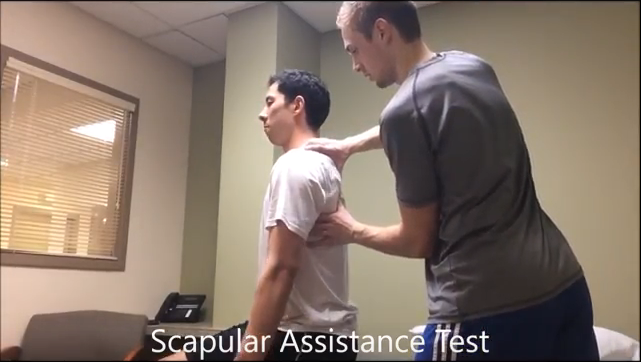
Find out why you are missing out if you’re not using the Scapular Assistance Test
There are plenty of special tests and diagnostic tools specifically for shoulder impingement. However, many of those tests involve combined shoulder internal rotation and flexion. These combined motions can often be symptomatic even in healthy shoulders because of how the stress the rotator cuff. The scapular assistance test does not place the glenohumeral joint in that vulnerable position. It is a simple and easy assessment tool that can also turn into a direct treatment. I use this test with any non-surgical patient experiencing true glenohumeral joint pain of a non-traumatic nature. It helps me rule in subacromial impingement as a contributing factor the the patient’s pain. I can then proceed to using the scapular assistance test as a direct treatment intervention and it works great!
Evidence for Scapular Assistance Test
An article from JOSPT concluded that the Scapular Assistance Test can be used to help identify patients in which decreased subacromial space is a contributing factor to shoulder pain. The test itself can increase scapular upward rotation and posterior tilt, resulting in increased subacromial space. If the patient has less pain during the Scapular Assistance Test compared to active motion, you can be confident as a clinician that subacromial impingement is a contributing factor to the patient’s shoulder pain.
Another article from JSES also concluded that the Scapular Assistance Test results in increased acromiohumeral distance. This conclusion supports the idea of using the Scapular Assistance Test as a treatment technique because of its ability to increase subacromial space and thus decrease impingement symptoms.
How to Perform the Scapular Assistance Test
Just prior to performing the test, I will have the patient flex their arm up in the scaption plane noting any pain and the point of motion restriction. I then perform the test. The test is performed with the patient in an upright seated or standing position. The therapist should be standing behind the patient and slightly toward the involved side. The therapist uses one hand to stabilize the clavicle and scapula in a semi-retracted position, while the other hand is placed along the medial border and inferior angle of the scapula. The therapist then instructs the patient to flex the arm up in the scaption plane. As the patient raises the arm, the therapist provides manual assistance to the scapula in the direction of upward rotation. Be sure to maintain the semi-retracted position. The overpressure provided by the therapist is intended to simulate the force couple of the low trap and serratus anterior muscles into upward rotation. If the patient has less pain during the assisted motion, the test is positive indicating decreased scapular control and resultant subacromial impingement.
Using the Scapular Assistance Test as Treatment
The technique from assessment to treatment doesn’t change at all. Simply provide the patient with manual overpressure of the scapula into retraction and upward rotation as the patient performs repetitions of active scaption. I often use this technique toward the beginning of my treatment sequence for two reasons. First, it helps to decrease any apprehension the patient may have toward overhead motion. It allows the patient to gain confidence in their ability to raise their arm overhead in a painfree range. Secondly, it serves as a great neuromuscular re-education drill and can help encourage the upward rotation force couple of the low trap and serratus anterior muscles.
I encourage you to try the Scapular Assistance Test with your next patient who exhibits signs and symptoms of primary shoulder impingement. Use it as part of your diagnostic process and transition it into a direct treatment as well. Perform some soft tissue mobilization of the shoulder girdle musculature and follow that up with 15 reps of active scaption with manual assistance of the scapula into upward rotation.
Let us know how it goes!
References
Seitz AL, McClure PW, Finucane S, et al. The Scapular assistance test results in changes in Scapular position and Subacromial space but not Rotator cuff strength in Subacromial Impingement. Journal of Orthopaedic & Sports Physical Therapy. 2012;42(5):400–412. doi:10.2519/jospt.2012.3579.