


Diaphragmatic Breathing: The Missing Link in Your Training Program
I recommend diaphragmatic breathing to many of my patients and I think it has a strong place in the athletic and sports performance realm. I think it is a great tool to add to your workouts, especially as an active recovery tool. I recommend practicing diaphragmatic breathing at the end of your workout as a way to relax and improve the oxygenation to your tissues to promote healing and elimination of waste products.
What is Diaphragmatic Breathing
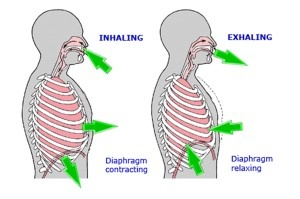
Diaphragmatic breathing is a breathing technique that has profound health benefits. It involves drawing air into the lungs by expanding the abdomen rather than the chest. When a person is born, he/she instinctively breathes using the diaphragm, but this technique is most often lost after about two years. Most people do not pay much attention to their breath on a day-to-day basis because it is an automatic involuntary response to the environment. This lack of attention to breathing causes people to develop the tendency to perform thoracic breathing, which involves expansion of the chest rather than the diaphragm. This type of breathing generally consists of many shallow breaths instead of few deep breaths like diaphragmatic breathing. One way to distinguish diaphragmatic breathing from thoracic breathing is by watching the chest or belly rise during an inhalation (Figure 1). The belly should rise high with diaphragmatic breathing.

The Physiology of Diaphragmatic Breathing
The diaphragm is a large muscle located between the chest and the abdomen. The process of diaphragmatic breathing involves contracting this dome shaped muscle (Figure 2). The contraction causes a vacuum effect that allows for more air to enter the lungs. When the muscle contracts it pulls the central tendon of the diaphragm down allowing for more air to be let into the lungs. The increase in volume causes a decrease in pressure in the lungs. With a decrease in pressure, the veins are able to more adequately return blood to the heart. Since the lungs are full of oxygen from the vacuum effect of the diaphragm and there is more blood localized around the lungs, there can then be more oxygen absorbed into the blood. Holding a breathe in longer allows for more oxygen to be absorbed into the bloodstream because there is more time for the oxygen to be diffused through the thin walls of the lungs to the blood. During the time in which oxygen is being diffused into the bloodstream, carbon dioxide is excreted from the blood into the lungs. When the air in the lungs is exhaled, the diaphragm returns to its dome shape and pushes the carbon dioxide out of the body.
The Benefits of Diaphragmatic Breathing
There are many known benefits associated with diaphragmatic breathing.
- Lung Expansion and Increased Oxygenation: Diaphragmatic breathing causes the lungs to expand more efficiently than thoracic breathing. This allows for better oxygen absorption into the bloodstream which enhances the functioning of the cardiorespiratory system and increases overall health and athletic stamina.
- Muscle Function: Oxygen is an essential nutrient that is required for almost all of the metabolic processes that occur in the body. With more oxygen absorbed by the blood, there is more oxygen available for the tissues in the body including the muscles. This increase in oxygen makes it more readily available for use during aerobic activity. With more oxygen available, the muscles will be able to function properly for a longer amount of time.
- Relaxation and Blood Pressure: Slow, deeper breathing allows for a more relaxed state of mind as well as muscle relaxation. When muscles are more relaxed, there is less stress on the heart so the heart rate slows down, which relaxes the nervous system. With less stress on the heart, there is a decrease in blood pressure because the heart does not have to work as hard to pump blood through the body. A reduction in blood pressure is a health benefit all in its own because high blood pressure is a risk factor for heart disease.
- Nutrient Exchange: Increased blood flow is another benefit of diaphragmatic breathing. The blood serves as transportation for the nutrients in the body. Increased blood flow allows these nutrients to be more easily transported to tissues of the body which improves overall health. Also, times of stress, lymphocytes (white blood cells) can more easily target foreign disease causing agents thus improving the immune system.
- Digestion and Waste Elimination: Deep diaphragmatic breathing also has an impact of digestion and waste elimination. The repeated contractile motions of the diaphragm have a massaging effect on the internal organs. This massaging serves to stimulate the internal organs, which speeds up the process of digestion.
Practical Uses of Diaphragmatic Breathing
The many benefits of diaphragmatic breathing make it a practical technique for everyone to focus on. Perhaps it is most commonly linked with relaxation practices such as yoga, tai chi, and other forms of meditation. It’s relaxing qualities make it a great practice for stress relief. Patients with phobias, anger issues, and other anxiety disorders are often taught diaphragmatic breathing in part of their treatment to help them relax.
I recommend diaphragmatic breathing to many of my patients and I think it has a strong place in the athletic and sports performance realm. I think it is a great tool to add to your workouts, especially as an active recovery tool. I recommend practicing diaphragmatic breathing at the end of your workout as a way to relax and improve the oxygenation to your tissues to promote healing and elimination of waste products.
How To Practice Diaphragmatic Breathing
When first practicing diaphragmatic breathing, it is best to be in a calm relaxing environment to allow oneself to focus only on breathing. Either sit upright with proper posture, or lie down with the knees bent. I recommend starting by lying on your back with knees bent. Start off by placing one hand on the chest and the other on the belly. Breathe normally and pay close attention to which hand moves the most. It the chest expanding more, or is the belly? Now focus on keeping the chest and rib cage still while only moving the belly during breaths. Focus on letting the diaphragm do the work, not the chest. Relax the neck and shoulders and take slow deep breaths in through the nose and slowly exhale either through the nose or mouth. The belly should be rising high with each inhalation. Breaths should be steady with only a minor pause between inhalation and exhalation. Breaths should be deep. Do not over exaggerate breaths; instead perform them at a slow but comfortable pace being sure to fill the lungs up on each inhalation. Practice this daily and eventually it will come naturally. It is possible to train the body to breathe using the diaphragm it just takes some practice and attention.
Other Resources
If you enjoy our content and are looking for more practical application tools, be sure to follow us on Instagram @physiostrength. That is where we post many exercise demonstrations and other exciting content. If you want to work with Dr. Naccarato and his team, please schedule an appointment directly through our online scheduling system.
As always, please SHARE our content with friends and family via social media. The more people we can reach, the more people we can help.
Sincerely,
Dr. Connor Naccarato, DPT, MTC, CSCS